Diego Rivera, LETTER TO ALBERTO MISRACHI
Diego Rivera
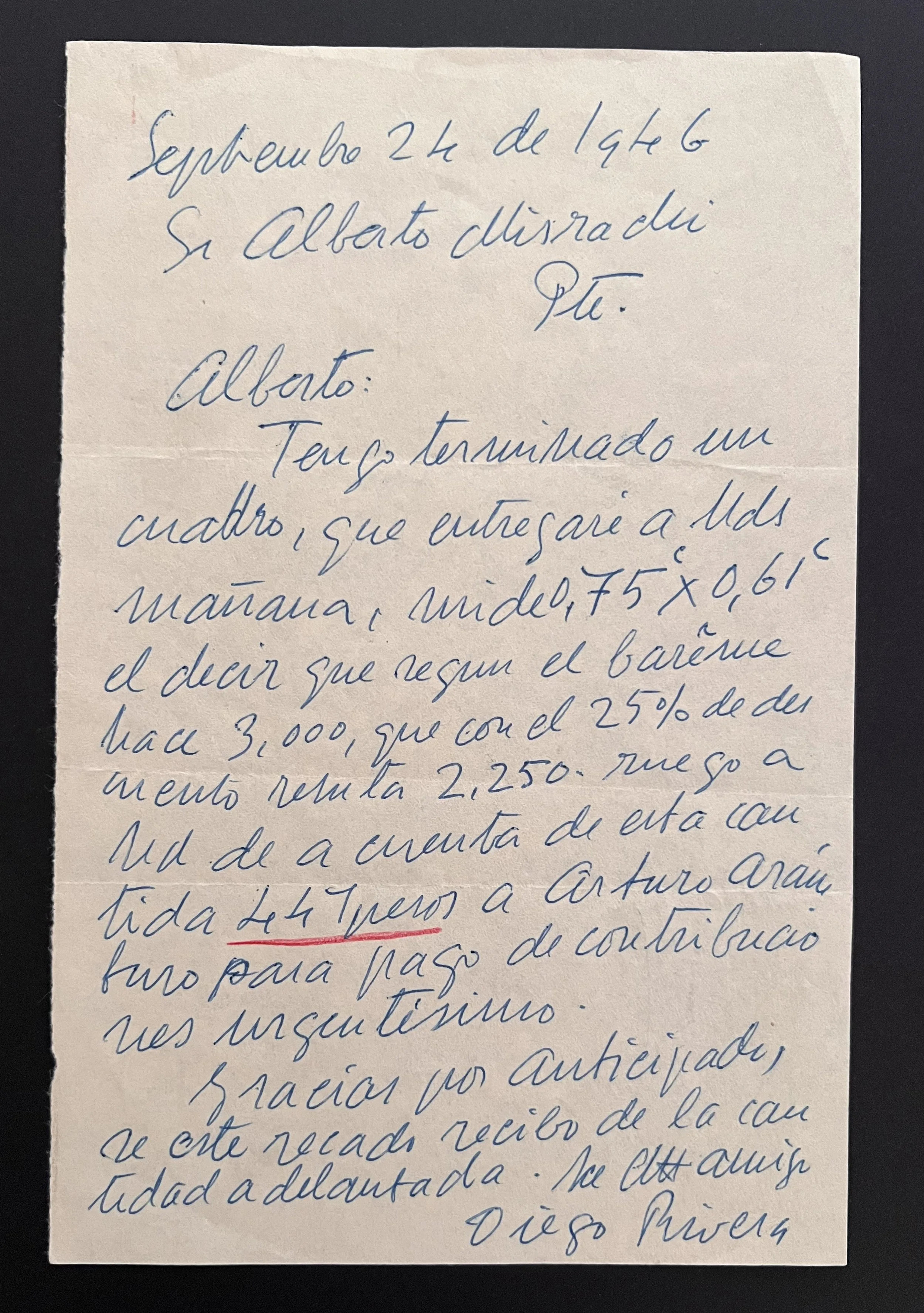
Letter to Alberto Misrachi
September 24, 1946
8.25 x 5.5 inches (21 cm x 14 cm)
Signed on front by Diego Rivera
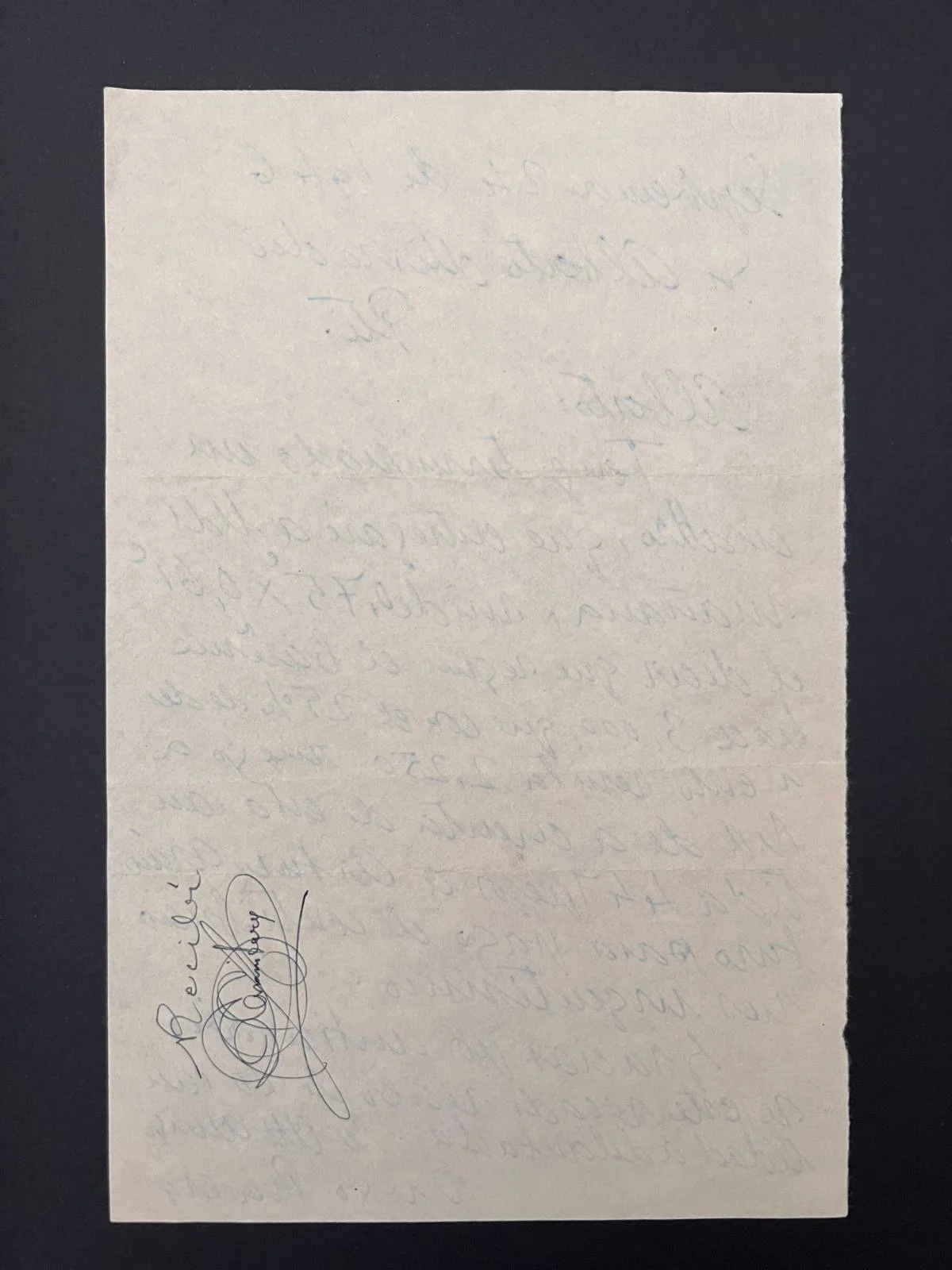
Signed on back by Alberto Misrachi
Provenance:
Heirs of Alberto Misrachi
images
Translation
September 24
Mr. Alberto Misrachi
Alberto,
I have finished a painting, that I will deliver to you tomorrow. It measures 75 cm by 61 cm, which according to the scale is worth 3,000, which with the 25% discount results in 2,250. I ask you pay, on account of this amount, 44 [mxn] to the account of Arturo Arau, for tax payment. It is very urgent.
Thank you in advance. With this letter I acknowledge receipt of the advance payment.
Sincerely,
Diego Rivera"
Further Information
This letter, written and signed by the hand of Diego Rivera, is a wonderful document from eighty years ago, communicating with Rivera's art dealer, Alberto Misrachi.
Misrachi was a giant in the art world in Mexico. A Macedonia-born immigrant naturalized as a Mexican citizen, he opened his first gallery on Avenida Juárez in the 1930s, directly across from the Palacio de Bellas Artes — encouraged, according to gallery accounts, by Rivera and Rufino Tamayo themselves. The gallery's bookstore-and-exhibition-space model made it a gathering point for the politicians, intellectuals, and artists who defined Mexico City's cultural life in the 1930s and 40s, and Misrachi became Rivera's primary dealer and financial steward for over a decade.
His connection to Frida Kahlo, however, ran on a different track. Misrachi was a close and devoted personal friend of Kahlo — close enough that she became godmother to his daughter, and close enough that Kahlo painted his portrait in 1947 in gratitude for his support.
This particular note captures the mechanics of the Rivera-Misrachi side of that relationship in miniature. Rivera writes to report that he has just finished a canvas — 75 x 61 cm — which he values, according to their agreed "barème" (the pricing scale the two had established for Rivera's easel paintings), at 3,000 pesos, or 2,250 after Misrachi's standard 25% dealer's commission. He then asks Misrachi to advance 44 pesos against that sum immediately, to cover a tax payment due that month. It's a small, almost mundane request, but it offers a striking glimpse into Rivera's day-to-day finances at the height of his fame: monumental muralist he may have been, but he still ran his easel-painting sales through Misrachi like a working artist managing cash flow, dependent on his dealer for quick advances against future income.
The date is telling. September 1946 finds Rivera on the cusp of one of the defining commissions of his career: that same year, the architect Carlos Obregón Santacilia invited him to paint what would become Sueño de una tarde dominical en la Alameda Central (Dream of a Sunday Afternoon in Alameda Central Park) for the newly built Hotel del Prado — the monumental fresco, painted through 1946–47, that remains one of his most celebrated works today. Mural commissions often paid slowly relative to their scale and labor; easel paintings sold through dealers like Misrachi were where Rivera's more immediate, liquid income came from. A letter asking for a fast 44-peso advance to make a tax deadline, set against the backdrop of Rivera preparing his Alameda masterpiece, captures that duality well.
It's also worth noting that 1946 was a fraught year in the Rivera-Kahlo household for reasons beyond money. That same year Kahlo traveled to New York for a spinal fusion surgery with Dr. Philip Wilson, an operation she hoped would relieve her chronic pain — it failed, and became the origin of her painting Tree of Hope, Remain Firm. Misrachi, as a close family friend as much as Rivera's dealer, would have been well aware of the personal strain surrounding the household at exactly the moment this letter was written.
The back of the letter carries Misrachi's own hand: he has written "Recibí" (received) and added his bold, looping signature — his formal acknowledgment of the note and, presumably, of the arrangement it set in motion. It's a small but valuable detail, transforming the sheet from a one-sided request into a completed exchange between the two men, with both of their hands present on the same document.
The letter was, until now, in the possession of the Alberto Misrachi heirs, passed down through his daughter, relating directly to a painting Rivera sold through Misrachi — giving us a glimpse into a moment in time in which Rivera communicates both as a friend and business partner. That it descended through Frida Kahlo's own goddaughter — only underscores how woven together the Misrachi and Rivera-Kahlo families were, even where formal business arrangements didn't extend.
The letter is in very good condition and has never been framed or exposed to light.
Inquire
View more work by Diego Rivera.